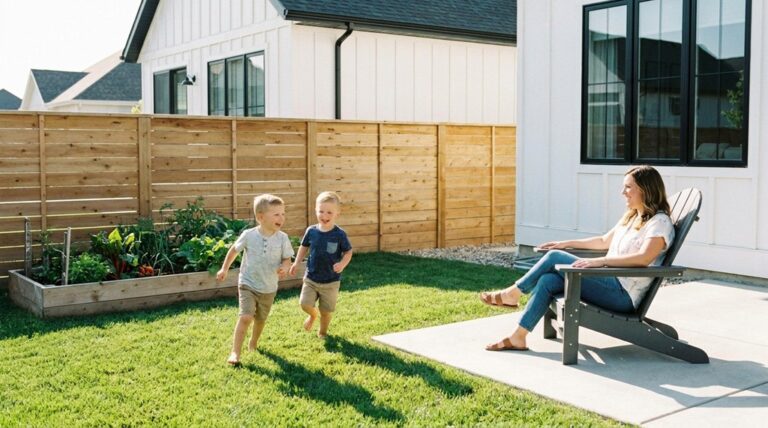



What you need to know now about single-family homes vs. townhouses:
- A single-family home is a fully detached house where you own the structure and the land beneath it. A townhouse is an attached home, sharing at least one wall, where an association usually owns or maintains the exterior and shared spaces.
- The real trade-off isn’t privacy versus community. It’s how much ongoing responsibility you want, and how much say an association gets over your home’s exterior.
Keep reading to see exactly what each type of home means for ownership, upkeep, privacy, and resale, so you can decide with real information instead of guesswork.
What Is the Difference Between a Single-Family Home and a Townhouse?
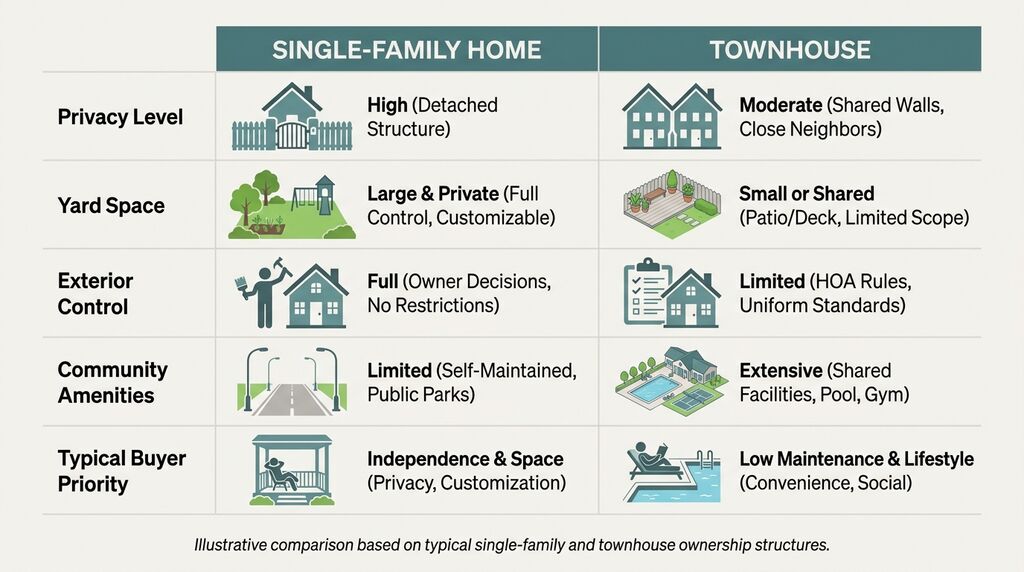
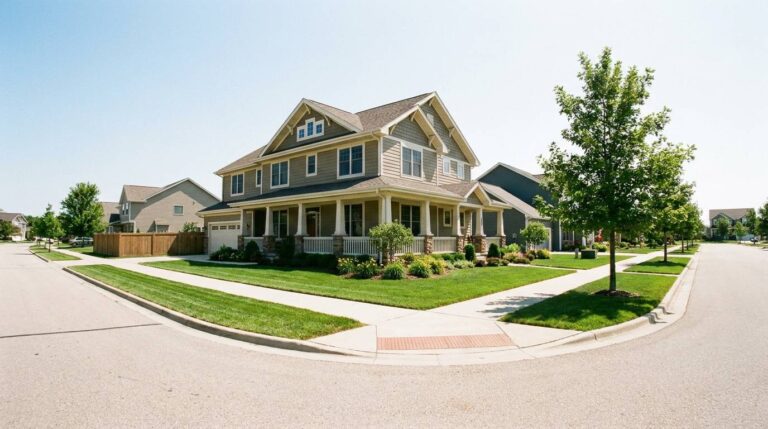
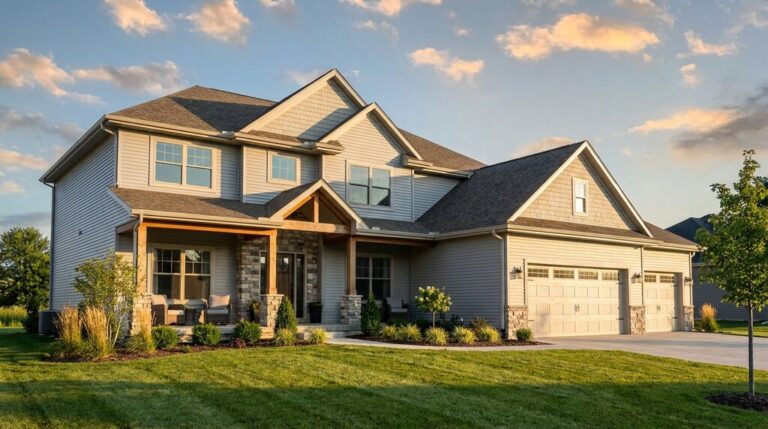
A single-family home stands alone on its own lot with no shared walls, and the owner holds title to both the structure and the land underneath it. A townhouse shares at least one wall with a neighboring unit, and while you own the interior, exterior maintenance and shared spaces are typically governed by a homeowners association.
In our conversations with buyers across the Omaha metro, the confusion almost never comes from the home itself. It comes from not knowing where their ownership actually ends and the association’s begins.
What Makes a Home “Single-Family”
The defining feature is separation. No shared walls, no shared roofline, and no association dictating what color you paint your front door.
You Own the Land
The lot is yours. That includes the front yard, the backyard, and everything on it.
You Control the Exterior
Siding, roofing, landscaping, and paint colors are entirely your call, within whatever local building codes apply.
What Makes a Home a “Townhouse”
A townhouse is legally a single-family structure, just an attached one. It shares at least one wall with a neighbor, and it’s almost always part of a homeowners association.
You Own the Unit
Ownership generally covers the interior and the structure itself, sometimes including a small private yard or patio.
The Association Often Owns the Rest
Common areas, shared roofs, and exterior walls are frequently managed collectively, with the association setting rules for how they’re maintained.
Want a home that’s entirely your own, inside and out? Regency’s semi-custom process starts with a single-family lot built around how you actually live. Learn About Our Semi-Custom Process →
Who Owns What? A Breakdown by Home Type
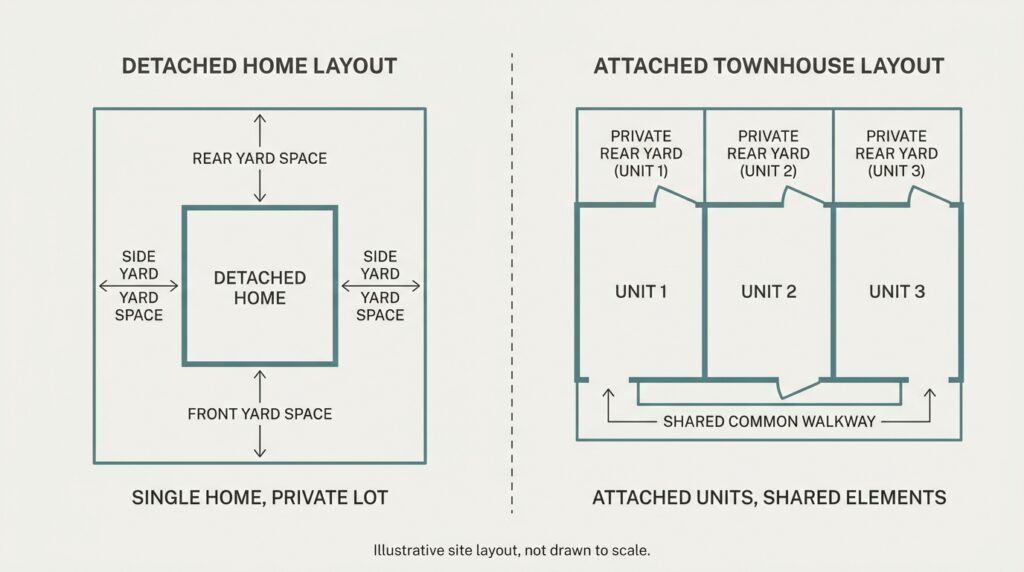
Ownership boundaries are the single biggest source of confusion between these two home types, and they affect everything from what you can renovate to who shows up when the roof needs work.
| What’s Involved | Single-Family Home | Townhouse |
|---|---|---|
| Land Under the Home | You own it outright | Often owned or held by the association |
| Front and Back Yard | Fully yours | Sometimes a small private patio; rest is shared |
| Exterior Walls and Roof | Yours to maintain and modify | Frequently owned or managed by the association |
| Driveway | Private, yours alone | May be shared or assigned |
| Pools, Clubhouses, Trails | Not applicable unless in a separate neighborhood association | Common in townhouse communities, funded through dues |
How Much Privacy and Space Should You Actually Expect?
Privacy comes down to two things: how many walls you share, and how the home was actually built. A single-family home gives you distance from every direction. A townhouse gives you distance on two sides at most, and sound transmission depends heavily on construction quality.
Sound and Shared Walls
Older attached construction can transmit sound easily between units. Newer builds with staggered framing and modern insulation cut that down considerably, so the age and quality of construction matter as much as the wall itself.
Yard and Outdoor Space
A single-family lot gives you a full yard to use however you want, including additions like a shed, a play structure, or a garden. A townhouse yard, when there is one, tends to be small and sometimes restricted by association rules on what you can put in it.
Who Handles Maintenance and Exterior Upkeep?
The honest answer is that both home types require maintenance. The difference is who’s responsible for which parts, and how much choice you have in the matter.
| Maintenance Task | Single-Family Home | Townhouse |
|---|---|---|
| Lawn Mowing and Landscaping | You handle it, or hire your own help | Usually included through the association |
| Roof and Siding Repairs | Your responsibility and your choice of contractor | Usually the association’s responsibility |
| Snow Removal | Your responsibility | Frequently handled by the association |
| Interior Systems (HVAC, Plumbing) | Always yours | Always yours |
| Exterior Paint Color and Materials | Entirely your decision | Usually set by association guidelines |
How Common Are HOAs, and What Do They Actually Do?

Homeowners associations are far more common than most first-time buyers expect, and they’re not exclusive to townhouses. According to the Foundation for Community Association Research, roughly 78 million Americans, nearly 1 in 4, currently live in a community governed by an association.
Most homeowners report a reasonably positive experience. The Foundation’s most recent outlook found 86% of residents rate their overall experience as good or neutral, and 87% say association rules protect property values or have no real effect either way.
An HOA isn’t inherently a downside. It’s a trade of some personal control for shared upkeep and consistent standards across the neighborhood. Whether that trade is worth it depends entirely on how much you value making your own exterior decisions.
Curious which Omaha-area communities fit your search? We broke down the neighborhoods drawing the most new construction activity right now. Read: Best Neighborhoods for New Construction in Omaha →
Which One Holds Its Value Better?
Land tends to appreciate independently of the structure sitting on it, which is why single-family homes are generally viewed as the stronger long-term hold. Owning the ground beneath your home means your investment isn’t limited to the building alone.
Townhouse construction has also cooled somewhat in the broader market. NAHB’s Eye on Housing reported that single-family attached starts made up under 16% of all single-family construction in the first quarter of 2026, down from a recent high, as affordability pressure cooled construction activity across the housing market.
Because single-family homes appeal to the widest range of buyers, from young families to retirees, they also tend to draw broader interest at resale. Local market conditions always play a role, but a wider buyer pool generally works in your favor when it’s time to sell.
Ready to see what’s currently available across the Omaha metro? Inventory changes often, so it’s worth a look while you’re weighing your options. See Available Homes →
Single-Family or Townhouse: Which Fits Your Life Right Now?
This is less a financial decision than a lifestyle one, even though money is part of it. A townhouse is often built to be a more accessible entry point, since shared-wall construction and smaller individual lots reduce what it takes to bring a home to market. A single-family home represents a bigger investment upfront, reflecting the larger lot and fully detached structure.
If your priority is minimizing exterior upkeep and you’re comfortable with association rules, a townhouse can genuinely fit well. If privacy, yard space, and full control over your property matter more to you than convenience, a single-family home is the better match.
There’s also a simpler way to think about it: buying a home is a personal decision first and an investment decision second. Weigh the lifestyle fit before you weigh the long-term numbers. You’re the one living there every day, and that daily experience matters more than the deed itself.
Neither choice is inherently safer or smarter. It comes down to matching the ongoing responsibility level, from move-in day forward, to how you actually want to spend your time.
Still comparing new construction against a resale property? We broke down what today’s Omaha buyers are actually seeing in both categories. Read: New Construction vs. Existing Homes in Omaha →
How to Decide Between the Two
Once you have a sense of which way you’re leaning, a few practical checks are worth walking through before you sign anything. None of these take long, and each one tends to surface something a listing photo or floor plan never will.
Walk Through a Typical Week
Think about lawn care, snow removal, and exterior repairs. Decide honestly whether you want to handle those yourself or hand them off through an association.
Test the Sound Question in Person
If you’re considering a townhouse, ask to visit during a busy evening. Newer construction with better insulation makes a real difference here, so don’t judge every attached home by an older one you’ve toured.
Get Specific About the Association
Ask what the association covers, how decisions get made, and whether any large projects are being planned. An engaged, well-run association looks very different from a distracted one.
Picture Your Yard Five Years From Now
If you want space for a garden, a swing set, or a dog that needs room to run, that points toward a single-family lot. If yard work isn’t something you want on your plate, a townhouse removes most of it.
Frequently Asked Questions about Single-Family Home vs. Townhouse
Can a Townhouse Have a Private Yard?
Sometimes. Some townhouse communities include a small private patio or fenced strip of yard attached to each unit, while others keep all outdoor space communal. It varies enough by community that it’s worth asking directly rather than assuming either way, since the answer changes what daily life actually looks like. If a yard matters to you, walk the specific unit and ask what’s deeded to the owner versus what belongs to the association.
Is It Harder to Get Financing for a Townhouse Than a Single-Family Home?
Not usually. Most conventional, FHA, and VA loan programs treat single-family homes and townhouses similarly, since a townhouse is legally classified as a single-family structure rather than a condominium. Lenders may ask additional questions about the homeowners association’s financial health, but the loan process itself follows a familiar path. It’s still worth confirming with your lender early, since association-specific paperwork can add a step to underwriting.
Can You Rent Out a Townhouse If You Decide to Move Later?
It depends entirely on the association’s rules. Some associations allow rentals freely, others cap the number of rental units allowed in the community at any given time, and a few restrict rentals altogether. This is worth confirming before you buy if keeping that option open matters to you, since rental caps can fill up and lock out owners who decide later that they want to lease their unit.
Do All Townhouses Have an HOA?
The large majority do, since shared walls and common areas generally require some form of collective management. A townhouse without any association at all is uncommon enough that you should verify maintenance responsibilities in writing if you come across one. Without an association, you’d need a clear agreement with neighboring owners about who handles shared structural elements.
Does Regency Build Townhouses, or Only Single-Family Homes?
Regency builds single-family homes exclusively, each on its own lot across communities in the Omaha metro. That focus is part of why the company has built new homes for Omaha-area families for more than 60 years, with every home designed around detached living rather than shared walls. If a townhouse is what you’re after, this comparison should still help you evaluate other builders with clearer eyes.
Your Next Home Should Fit How You Actually Live
Regency has built single-family homes across the Omaha metro for more than 60 years, a track record that earned the company recognition as a Best of Omaha winner in 2026. From Papillion to Bennington, Gretna to Elkhorn, every home we build sits on its own lot, with no shared walls and no association dictating what your exterior looks like.
Whichever direction fits your life better, the decision deserves real information rather than a guess. We’d rather walk you through what ownership actually looks like than let you find out after closing.
Ready to talk through what fits your family best? Call our New Home Counselors at 402-256-5727 or reach out below to start the conversation. Contact Regency Homes →